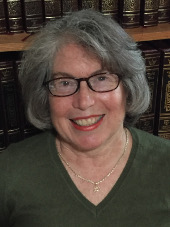
I just learned that I received a 2023 Rockower Award, otherwise known as the Jewish Pulitzers. And what is a Rockower Award you may ask, as I did? Briefly, in 1979, as a century tribute to him by his sons, the Rockower family created the Simon Rockower Jewish Journalism Awards to honor him and his deep love for the craft of Jewish Journalism. These prestigious awards honor achievements in Jewish media. Awards were presented at the 42nd Annual Simon Rockower Awards Banquet held in conjunction with the American Jewish Press Association’s 2023 Annual Conference, July 11, 2023, in New Orleans, LA.
My award was in Division B. Magazines and Monthly Newspapers.
First Place: Jewish Currents, Brooklyn, NY “Under the hood” by Zoé Samudzi.
Second Place: Lilith Magazine, New York, NY “Mama lives on” by my friend and colleague, Ilana Kurshan. Click here to view her submission.
Last but not least, I received Honorable Mention Award for Excellence in Arts — Review/Criticism for my book review of "Dirshuni: Contemporary Women's Midrash" in
Moment Magazine, Washington, DC, “Studying Talmud with Beruriah." Click here to view mysubmission.
As I was preparing to visit Israel, I came across an article about the synagogue mosaic being unearthed at Huqoq , a kibbutz near where we’d be staying in the Golan. Since 2011, excavations led by Dr. Jodi Magness of the University of North Carolina at Chapel Hill have been bringing to light a monumental, Late Roman (early fifth century C.E.) synagogue paved with stunning mosaics depicting a variety of biblical scenes and the first non-biblical story ever discovered decorating an ancient synagogue.
I emailed Dr. Magness in hopes of visiting the site, but unfortunately for me, her work was finished. The Israel Antiquities Authority [IAA], responsible for excavating, preserving and investigating antiquities sites, was taking over. It invests great efforts in the development and preservation of ancient buildings in Israel's historic cities. Under their authority the mosaic had been buried and the site placed under guard until such time that the IAA could prepare the site to become a national park.
It’s now a month since we returned home from Israel. The chocolate goodies we made, along with the forbidden fruit I brought back, were eventually eaten, empty suitcases are finally back up in the attic and finished photo albums have been delivered (of course there were a few mistakes like including the same pictures twice). Just as I’m focusing on current activities like when to see Barbenheimer and future ones like planning a December vacation, I get an email from the Biblical Archaeology Society, of which I’m a member, with a link to an article titled Jewish Worship, Pagan Symbols: Zodiac mosaics in ancient synagogues. Since I’ve visited most of the synagogues mentioned over the years, including a few of them last month, I read the article. It is very informative and I even learned something.
Tuesday, June 20. Our plane back to LA was leaving at 11:50 pm so we tried to pack in as many activities as possible on the drive from the Golan kibbutz to the Tel Aviv airport. First we drove west to Akko/Acre to see an archeological treasure, the crusader fortress, built by the Knights Templar in the 12th century. At the time it was built, the city was one of the main ports of Israel, and the fortress was built directly in the center to ensure the vital supplies coming to and from Europe. The fortress is an impressive structure, not just because of its huge size but because of the brilliant preservation that has taken place since its re-discovery. Inside are dining rooms, public bathrooms, and most impressively, huge halls used for varying purposes. The crypt that lies underground contains crusader tombstones and the tunnel that leads to it is as small today as it once was, so my tall (6'7") grandson and son-in-law stayed behind.
Our next stop was across the bay in Haifa, the beautiful Holy Bahai Gardens. We didn’t have time to tour them, but we were able to park at the overlook and take photos. Then it was south to Caesarea National Park, located right on the beach. Its most impressive structure is the theater. People from the highest and lowest walks of life came here to enjoy dramas and comedies. The shape of the theater was influenced by the classic model of Roman theaters: a semi-circle, in which were built blocks of cavea (seats) separated by vomitoria (entrances and exits), and the arena – an area at the foot of the seats used for the performances. The theater serves in this capacity to this day–its stage is used for performances by the greatest artists in the country.
Our final stop before the airport was Old Jaffa where we did some shopping. The small, narrow streets are home to unique boutiques, designer shops and other fascinating stores. We ended up on a street specializing in antiquities, where The Gallery had a wonderful collection of old coins, jewelry and art—some of which was actually affordable. My grandson and I avoided the bargaining by crossing the street to watch a wonderful sunset. It was a perfect finale to our trip.
This was the big bar mitzvah day. But since the ceremony wasn’t until 4 pm in Zippori Natl Park, I had time for a leisurely morning walk past all the scrap metal sculptures by the local artist, Yoop de Yons (aka: Joop de Jons). I took photos of dozens of them, which are posted on Facebook. We stopped to pick up lunch at an Aromas on the way, and ate at a shaded patio outside the visitor center. Zippori was once the capital of the Galilee, the seat of the Sanhedrin and the place where the Mishna was completed. It is also where many of the Israel scenes of my duo of Rav Hisda’s Daughters historical novels are set. The last time I was there was in 2012, and a great deal more of the ancient city has since been uncovered.
We spent most of our time before the bar mitzvah viewing ancient mosaics. The most famous is undoubtedly the mosaic scholars call the Mona Lisa of the Galilee. The mosaic work is of much finer detail than many other mosaics of the time. The second most significant mosaic is found in a restored villa from the 3rd century. There visitors can view a mosaic that illustrates scenes from the life of Dionysus, the Roman god of wine. Additional mosaics are found in the synagogue, but the largest and most impressive mosaic is located in the 5th century Nile Building. Archeologists believe the Nile Building served some kind of public function and was once completely paved with colorful mosaics. The Nile Mosaic originally covered the entire floor and portrays landscape scenes around the Nile River in Egypt and various hunting scenes.
At 3 pm it was time to convene at the ancient synagogue – a long narrow basilica-like structure, dated to the end of the Byzantine period, containing an impressive mosaic floor divided into four parts: the Sacrifice of Isaac, the signs of the Zodiac, a description of the Tabernacle in the desert and the Arc of the Covenant in the Jerusalem Temple. We chose that site for Ben’s bar mitzvah for three reasons: the historical significance of Zippori, the synagogue’s beauty, and—most important in late June—it’s air conditioned. We hired Reform Rabbi Or Zohar to officiate and prepare Ben for the ceremony, which involved Ben learning a whole new Torah portion and writing a new drash. The Sephardic Torah scroll, enclosed in a beautiful vertical silver case, allowed Ben to read his portion at eye level. The advantage of a Monday afternoon bar mitzvah is that the service is shorter than a morning one, and thus he chanted merely three sections of three lines each. The Jerusalem Talmud requires only seven for a minyan, which our family, guide, drive and rabbi provided. Later that evening, we had a delicious celebratory dinner prepared by two professional chefs who lived in the Meron Golan Kibbutz.
Sunday, June 18. Ben likes hiking almost as much as hot baths, so we headed for the Banias Nature Reserve. The Banias River (Hermon Stream) is one of the 3 tributaries of the Jordan River It is not the biggest in terms of waterfowl, nor in terms of length. However, it is the most scenic of the three. 80% of its water comes from one big spring, called the Banias Spring. In addition, a few streams that flow down from Mt. Hermon and the Golan heights add more water to the river, flowing for about 3.5 km through a gorge, eventually coming to the impressive Banias Waterfall, the largest in Israel. There is a 2 km hiking trail to the falls shaded from the hot summer sun by the impressive shade of the dense, lush green forest.
From there we stopped briefly at Kibbutz Dan, the northern starting point of the Israel National Trail, where our guide lives. We toured their underground bomb shelter, petting zoo and a large grass playing field with a captured/abandoned Syrian tank in the middle. Unfortunately, their Beit Ussishkin Nature Museum was closed. But a nearby Aroma Coffee Shop was open, and we enjoyed an excellent, and inexpensive, lunch.
Finally we arrived at our afternoon destination, the Galita Chocolate Farm where we had reservations for a family Chocolate Workshop. Of course we made sure to get there early to sample their ice cream and other chocolate desserts.
Saturday, June 17. We slept late for Shabbat, because we only had two excursions planned. Our first started with a drive down the east side of the Sea of Galilee to Umm el-Kanatir/Ein Keshatot, an archaeological site about 30 miles east of Tiberias. Excavations at the site proved it was a Jewish prosperous village in the Byzantine period, yet abandoned after earthquake of 749 CE. Its elaborate ancient synagogue, now fully restored, is the best-preserved example of synagogues in the Golan Heights from the time of the Talmud. The most interesting part of our visit was a movie at the modern visitors center that documents how restoring the ancient synagogue was done. The project, inaugurated in 2003, used special high-tech computer technology to code and digitally record the stones. Blocks were then labelled with RFID chips and a special crane lifted and inserted them in the correct sequence. With the help of this technology, the synagogue has been restored with great accuracy. This painstaking project took 15 years, and was completed in 2018.
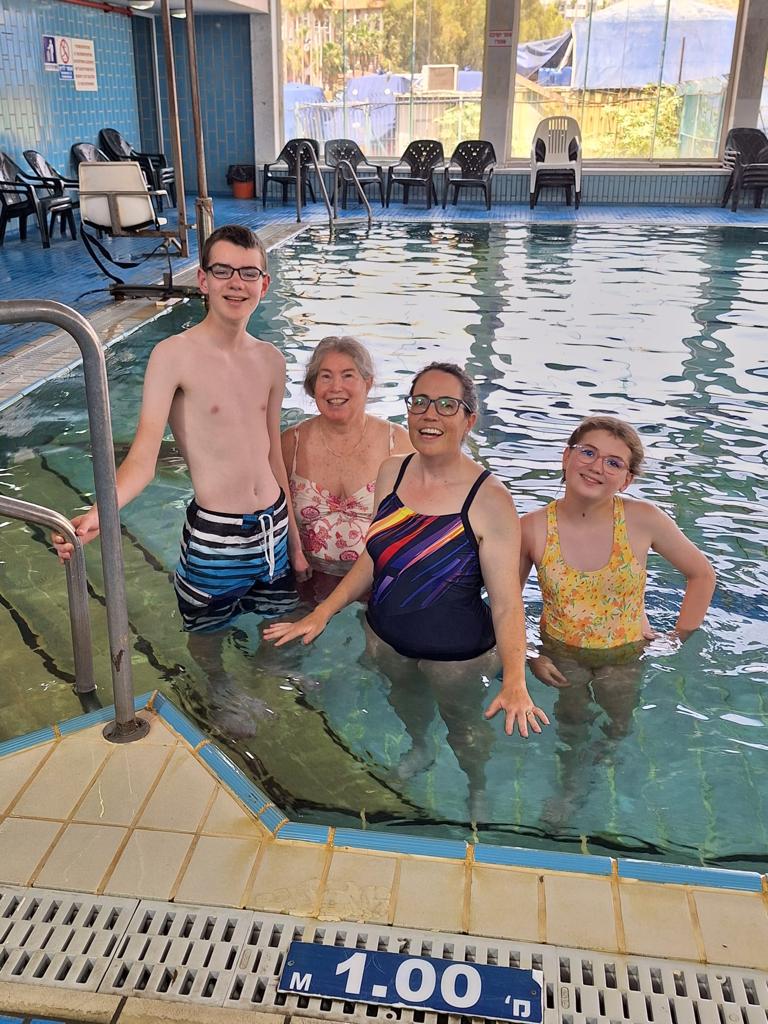
After that, we headed to Tiberias. Ben, whose bar mitzvah would be the following Monday, is a huge fan of hot baths, for which the area’s 60°C/140°F natural, bubbling waters are famous. We spent much of the afternoon at Tiberias Hot Springs, a modern spa with a large, warm indoor mineral pool (35°C/95°F), a hotter (40°C) outdoor pool and a cool (30°C) outdoor one right near the lake's edge. We had lunch at its casual restaurant before visiting Hamat Tiberias National Park, home to one of the most spectacular mosaics of ancient synagogues in Israel. The mosaic is divided into three panels. The northern section shows two lions, flanking nine inscriptions in Greek memorializing donors; including a person named Severus. Some call this synagogue after him – Severus’ Synagogue. In the middle – a spectacular Zodiac surrounding an image of Helios, the sun god; and in the southern section – the Ark of the Torah with Jewish symbols such as two seven-branched candelabras, a shofar and a lulav.
We’d considered both of these ancient synagogues as locations for Ben’s bar mitzvah. Unlike our son Ari’s bar mitzvah tour to Israel in 1994, where the choice of location was either the Western Wall or Masada, today there are 22 sites in the Israel National Parks system that are available for private ceremonies, usually bnai mitzvahs or weddings.
Friday, June 16. Our first day in the Golan was going to be devoted to outdoor activities. Our first venue to explore would be Nimrod Fortress Nature Reserve but because I was so enamored of local ripe cherries and apricots, we stopped briefly at a Druze village farmers’ market. The fruit was wonderful, and such a deal: 2 kg/4.4 lbs for 10 shekels/$ 2.75. I still had some leftover to bring back to LA on the plane, but more about that later.
It was beautiful clear day, all the better to see the views from Nimrod Fortress, a mountain-top Crusade-era castle stronghold spanning back to the 13th century. We entered through the 89 foot Secret Passage with its high arched ceilings below the Northwest Tower, continued upward to the “Beautiful Tower,” a semicircular room with a great faceted pillar holding up the vaulted stone roof. A large Arabic inscription outside shows it was built by the Baybars during the Mamluk period in 1275.
From there it was a brief drive to Tel Dan Nature Reserve , where we immediately started on the “Long Trail” to the Dan Spring, where the Dan Stream rises–the largest and most important of the sources of the Jordan River. Along the hiking trail were both shallow wading pools of refreshing, cool water and calmly babbling brooks creating channels along which the well-developed riverside forest offered charming and shady corners. Eventually we came to Tel Dan itself, one of the largest ancient tels in Israel, with the remains of a 5000 year old city, whose height of development was during the Canaanite and Israelite periods.
Of course we had to eat lunch at Dag Al HaDan Trout Restaurant. Set amid the streams of the Dan River's headwaters, it was a delightful spot for a dairy meal. We ate outside, on tables beside willow trees and brooks. Emily and I dined on excellent grilled trout, while the others enjoyed tasty vegetarian entrees. Our bellies full, we spent the rest of the afternoon gently kayaking down the Dan River.
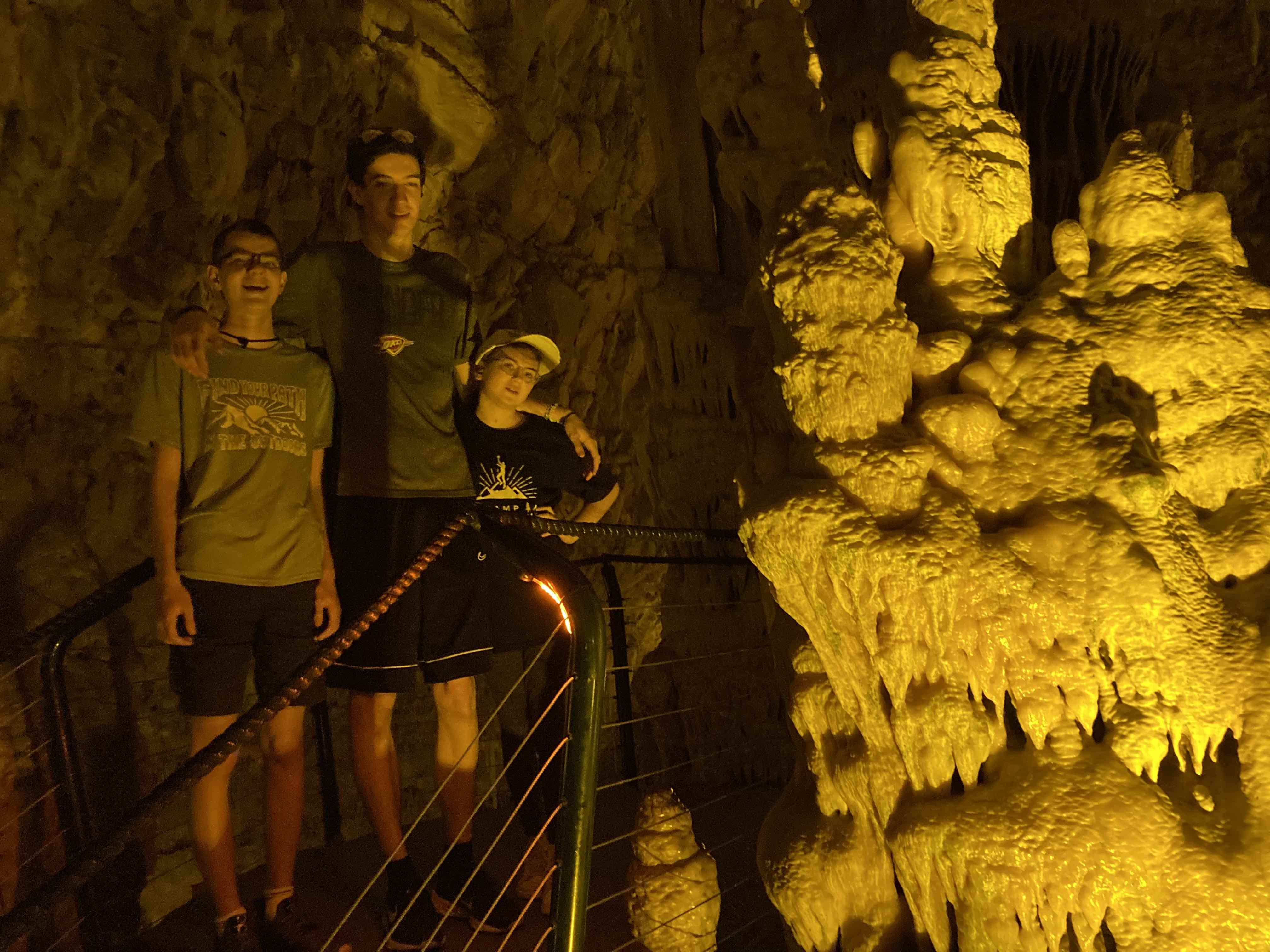
This morning, June 15, we reluctantly checked out the Dan Panorama Jerusalem Hotel to continue our trip into the Galilee. But first we stopped at the Soreq Stalactite Cave Nature Reserve. My husband and I toured that amazing underground site on our last two trips to Israel, and I was determined that my family see them. Unlike the previous time, when we had to go in a large group, there were no other people waiting to enter. Since we were with our own licensed tour guide, they let go through by ourselves after we watched a short film. Even though I knew what was inside, I stopped in awe on the raised platform that gave a panoramic view of the variety of shapes of the stalagmites and stalactites illuminated by special artificial lighting in lively colors. We followed a raised path from which we got different and closeup views of the various formations, along with dozens of photos.
Next we drove to Bet Guvrin-Maresha National Park, a Unesco World Heritage Site. The archaeological site contains some 3,500 underground chambers distributed among distinct complexes carved in the thick and homogenous soft chalk of Lower Judea under the former towns of Maresha and Bet Guvrin. Situated on the crossroads of trade routes to Mesopotamia and Egypt, the site bears witness to the region’s tapestry of cultures and their evolution over more than 2,000 years. These quarried caves served as cisterns, oil presses, baths, columbaria (dovecotes), stables, places of religious worship, hideaways and, on the outskirts of the towns, burial areas. Some of the larger chambers feature vaulted arches and supporting pillars. The Bell Caves are the main reason visitors come here. In total there are at least 800 bell shaped caves in the park, some of which are linked by underground tunnels. These caves were quarried during the 4th to 9th century when the chalk was used to make roads, plaster and mortar. The wide holes in the cave ceiling where chalk was extracted provided illumination but it was a little scary to walk down the narrow stairs.
After a four-hour drive, with a stop for gas and ice cream, we arrived at our second lodgings, Kibbutz Merom Golan. This six of us checked into our three cabins; each with a living room, modern bathroom, bedroom for two and fully-equipped kitchen (microwave, refrigerator, dishes, et). I particularly appreciated the numerous unusual metal sculptures by the local artist, Yoop de Yons (aka: Joop de Jons)
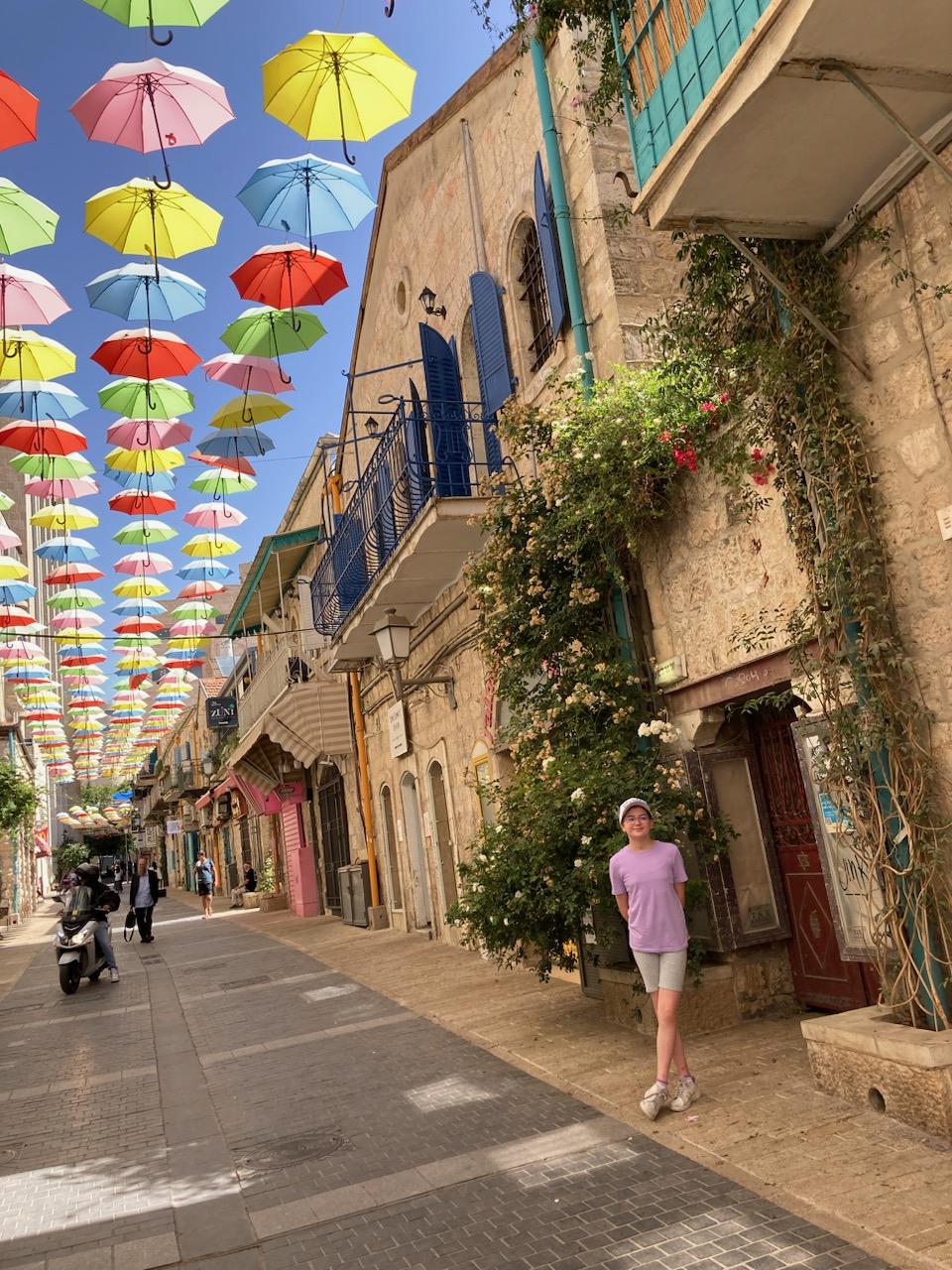
Wednesday, June 14 was a long day with lots of walking, but at least it was all in Jerusalem. First, upon learning that ten is the minimum age allowed to visit Yad Vashem, Israel's official memorial to the victims of the Holocaust. It is dedicated to preserving the memory of the Jews who were murdered; echoing the stories of the survivors; honoring Jews who fought against their Nazi oppressors and gentiles who selflessly aided Jews in need; our family decided that I would take ten-year old Eleanor with me to the new Hebrew Music Museum https://hebrewmusicmuseum.com/ located just south of the Ben Yehuda pedestrian mall, between Shamai and Hillel Streets. The music museum was as great as I’d hoped. We donned headsets and carried iPads that let us individually experience the rare and ancient musical instruments from different historical periods and diasporas. The museum interior has an impressive architectural structure encompassing 7 rooms designed according to different cultural, musical styles. Since each visitor is listening through their own headset, it was great fun to dance to music in an otherwise silent room.
This was followed by a food tour and lunch at Mahane Yehuda Market https://en.machne.co.il/ Everyone else was already there when Eleanor and I caught up with them. All the different stalls and stores overwhelmed us with the variety of foodstuffs for sale, nearly all of which offered samples first. The cherries and apricots were perfectly ripe and so sweet. We also stopped to taste, and buy, some cheeses before indulging at a fragrant herb shop. Nathan and Eleanor weren’t interested in the exotic tastings, and since it was only a mile back to our hotel and they were tired, they went off by themselves. It was no coincidence that their route took them past the local pizza place that we’d discovered the first day.
Unfortunately, I thought, they missed out on the finale of our day, the world-class Israel Museum, home of the Dead Sea Scrolls [https://www.imj.org.il/en/wings/shrine-book/dead-sea-scrolls] and other antiquities. Frankly, I would have appreciated more time there myself, even though I’d been there on earlier trips to Israel. But by the time the Museum closed at 5 pm, we were so exhausted we barely had energy enough to take a photo at the “Ahavah” sculpture.
Tuesday, June 13 would be another long day, but not so exhausting since we’d spend much of it in our guide’s comfortable van—equipped with Wi-Fi even. We breakfasted early, but I didn’t need to pack a lunch because we’d be dining at Herod’s Dead Sea Hotel. However, our first stop was a tour of Masada National Park. On previous visits to Masada I’d walked/hiked to the top with my husband, one time early enough to see the sun rise over the desert below. But we had much to do, and nobody wanted to get up that early when there was a new cable car that held 80 people and only took 15 minutes from the new visitor center to the ruins on top. Thankfully we took plenty of water, and it wasn’t that hot. To our surprise it began to rain, a rare occurrence, which quickly thinned out the crowds. So we learned more about King Herod, who was so rich, and paranoid, that he built a castle at the top this nearly inaccessible hilltop. The remodeled gift shop had lots of souvenirs to peruse, as well as a small café with lots of frozen snacks—which is where I fell in love with Magnum’s Double Raspberry ice cream bar.
Our next stop was Herod’s Dead Sea Hotel, where we changed into swimsuits and floated around on the Dead Sea a little while before showering, dressing and enjoying an excellent buffet lunch. The Dead Sea was even saltier than my previous visit, so much so that it was impossible to stand up once floating unless it was shallow enough to sit on the salt-covered ground first. It was also so salty that even the smallest cut or sore burned painfully, which quickly sent several of us into the regular pool.
On our way back to Jerusalem, we stopped and frolicked in the fresh-water aquifer-fed pools at the Enot Tsukim Nature Reserve, which also houses the ruins of a Roman villa where balsam perfume was processed. At the turnoff near Jericho, we paused briefly to gas up the van, where we resisted the temptation to get our photos taken on a pair of well-dressed camels. We then passed several Bedouin villages where children were herding goats near the road. Our guide told us a great deal about the Bedouin culture and people, including that they don’t travel from site to site in caravans anymore.
A big difference between this trip and previous overseas vacations is that we had only done two excursions a day before, whereas starting Monday, June 12, we had scheduled three. After my Sunday experience, I decided that I would prefer to not join the rest of the family to explore the underground City of David water tunnel . Instead I sat in the plaza above the entrance where there was excellent people watching as bus after bus disgorged its passengers, from elderly church groups to Birthright Israel young adults. I also visited the gift shop, enjoyed a musician playing the large hand harp, and walked upstairs to view the Silwan neighborhood with an tour group whose guide gave a detailed explanation of the area’s history.
We returned through the Western Wall and, visited someplace I would not have gone on my own, the Dome of the Rock (Al-Aqsa Mosque), aka The Temple Mount. Of course we couldn’t go inside, but the beautiful Islamic architecture and mosaics were impressive.